


Registration
Fill the common application form
2

Add to Compare
Add to Compare
Add to Compare

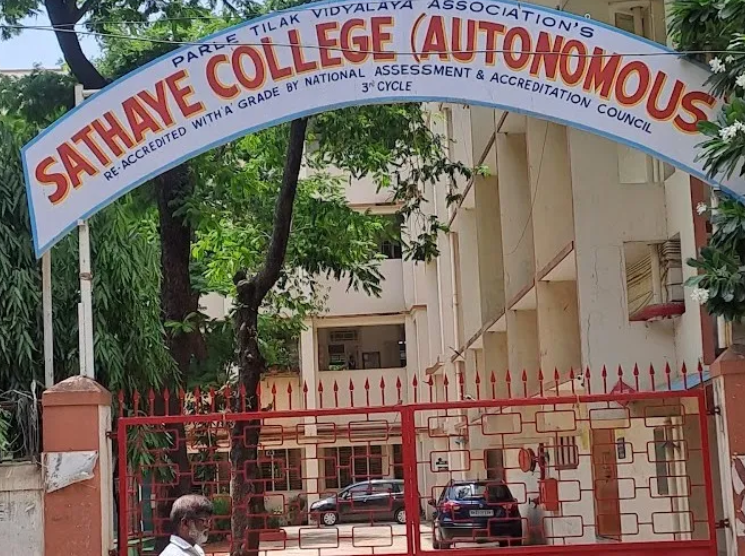

Operating under the Parle Tilak Vidyalaya Association (PTVA), Sathaye College (Autonomous), Vile Parle (East), Mumbai offers 2-year full-time postgraduate master’s degrees affiliated with the University of Mumbai. Aligned with the National Education Policy (NEP) under the autonomous Choice Based Credit System (CBCS), the postgraduate curriculum balances research methodology, enterprise tools, and on-ground practical training.
This curriculum guide covers course architecture, semester-wise subjects, laboratory modules, and practical components for six master’s degrees:
1. M.Sc. Information Technology (M.Sc. IT)
The M.Sc. Information Technology program prepares students for enterprise cloud computing, cybersecurity, infrastructure architecture, and full-stack software development.
Program Snapshot
Semester-Wise Syllabus & Subject Breakdown
| Semester | Core Theory Courses | Practical & Laboratory Work |
|---|---|---|
| Semester I | • Research in Computing & Technical Writing
• Data Science & Algorithmic Principles
• Cloud Infrastructure & Virtualization Services
• Advanced Software Engineering & Project Architecture | • Data Science & Python Scripting Lab
• Cloud Configuration & Management Lab
• Mini Software Development Sprint |
| Semester II | • Modern Networking & Security Architecture
• Enterprise Big Data Systems
• Mobile Computing & Cross-Platform Architectures
• Artificial Intelligence Foundations | • Network Penetration Testing & Defense Lab
• Big Data Tooling Lab (Hadoop/Spark Ecosystem)
• AI Algorithms Practicum |
| Semester III | • Technical Cybersecurity & Digital Forensics
• Distributed Systems & Cloud Microservices
• Database Technologies & Optimization Techniques
• Applied Machine Learning Operations (MLOps) | • Advanced Cloud Infrastructure & Automation Lab
• Incident Response & Digital Forensics Lab
• Software Architecture Testing |
| Semester IV | • Deep Learning & Cognitive Computing
• DevOps Methodologies & CI/CD Pipelines
• Blockchain Architecture & Smart Contracts (Elective)
• IT Governance, Compliance & Ethical Law | • Major Industrial Dissertation & Research Project
• Enterprise Software Deployment Viva
• Comprehensive Practical Exam |
2. M.Sc. Data Science
The M.Sc. Data Science program equips learners with predictive modeling, enterprise data warehousing, big data processing, and business analytics capabilities.
Program Snapshot
Semester-Wise Syllabus & Subject Breakdown
| Semester | Core Theory Courses | Practical & Laboratory Work |
|---|---|---|
| Semester I | • Mathematical & Statistical Foundations for Data Science
• Exploratory Data Analysis & Advanced Python/R
• Data Warehousing, Relational Modeling & NoSQL Systems
• Research Methodology & Quantitative Analysis | • Advanced Python & Statistical Programming Lab
• SQL Querying, Indexing & Data Cleansing Lab
• Experimental Dataset Explorations |
| Semester II | • Supervised & Unsupervised Machine Learning
• Big Data Analytics & Distributed Computing Engines
• Cloud Data Engineering (AWS/Azure/GCP Pipeline Builds)
• Visual Analytics & Enterprise Dashboarding (Power BI & Tableau) | • ML Model Building & Scikit-Learn Practicum
• Apache Spark, Kafka & Big Data Processing Lab
• Enterprise Visualizations & Storytelling Lab |
| Semester III | • Deep Learning & Neural Network Architectures
• Natural Language Processing (NLP) & Text Mining
• Time-Series Forecasting & Econometric Modeling
• Data Privacy, Ethics, PDPL & Model Governance | • Deep Learning Frameworks (TensorFlow/PyTorch) Lab
• NLP Preprocessing & Transformer Pipeline Lab
• AI Certificate Course & Industry Use Cases |
| Semester IV | • Generative AI & Large Language Model (LLM) Systems
• Agentic AI Workflows & Automation for Business
• Domain Analytics (FinTech, Retail & Supply Chain Analytics)
• Applied High-Performance Computing | • Capstone Data Science Research Project / Dissertation
• Live Industry Data Sprint Defense
• Production Deployment Practicum |
3. M.Sc. Zoology
The M.Sc. Zoology curriculum provides advanced scientific training in animal physiology, environmental biotechnology, molecular genetics, and biodiversity conservation.
Program Snapshot
Semester-Wise Syllabus & Subject Breakdown
| Semester | Core Theory Courses | Laboratory & Field Components |
|---|---|---|
| Semester I | • Advanced Non-Chordate Biology & Structural Adaptations
• Comparative Vertebrate Anatomy & Physiology
• Biochemistry & Enzymology for Life Sciences
• Research Methodology & Biostatistics | • Taxonomy, Anatomical Dissections & Slide Preparations
• Quantitative Biochemical Estimations Lab
• Ecological Habitat Mapping & Field Record Maintenance |
| Semester II | • Cell Biology, Molecular Genetics & Genomics
• Developmental Biology & Reproductive Physiology
• Environmental Ecology & Toxicology Assessment
• Applied Immunology & Diagnostic Techniques | • Molecular Biology Lab (DNA Extraction, Gel Electrophoresis)
• Toxicological Bioassay Practicum
• Institutional Laboratory Training & Field Report |
| Semester III | • Specialized Specialization (Oceanography / Entomology / Cytogenetics)
• Applied Biotechnology & Industrial Fermentation
• Biodiversity Conservation, Wildlife Protection Laws & GIS
• Bioinstrumentation Techniques & Electron Microscopy | • Specialized Elective Laboratory Experiments
• Wildlife Sanctuary / Marine Ecosystem Field Visit
• Bioanalytical Instrumentation Practicum |
| Semester IV | • Advanced Animal Physiology & Neurobiology
• Pharmacology & Pharmacogenomics Fundamentals
• Forensic Biology & Cytogenetic Analysis
• Biosafety, Bioethics & Research Intellectual Property | • Master's Research Project / Dissertation Submission
• Scientific Seminar Presentation
• Comprehensive Practical Assessment & Viva Voce |
4. M.A. Communication and Journalism (MACJ)
The M.A. Communication and Journalism (MACJ) is a bilingual (English & Marathi) professional media degree designed for multimedia newsrooms, broadcast studios, and digital content channels.
Program Snapshot
Semester-Wise Syllabus & Subject Breakdown
| Semester | Core Theory Courses | Studio, Production & Practical Modules |
|---|---|---|
| Semester I | • Communication Theory, Models & Media History
• News Reporting, Critical Gathering & Beat Writing
• Media Laws, Constitutional Ethics & Press Freedom
• Sociological Perspectives of Mass Media | • Print & Web Editorial Writing Exercises
• Camera Handling, Visual Composition & Photography
• Audio Recording & Podcast Production Workshop |
| Semester II | • Television Journalism & Broadcast Production Workflow
• Radio Programming & Digital Audio Journalism
• Investigative Journalism & Right to Information (RTI)
• Web Journalism, Social Media Reporting & SEO for Editors | • TV Newsroom Simulation & Teleprompter Anchoring
• Video Editing Suites (Premiere Pro / FCP Practicum)
• News Bulletin Production & Field Reporting Assignment |
| Semester III | • Data Journalism & Information Visualization
• Development Journalism & Public Policy Analysis
• Media Management, Press Economics & Entrepreneurship
• Regional & International Geopolitical Reporting | • Multiplatform Content Publishing Project
• Digital Fact-Checking & Verification Lab
• Specialized Beat Dossier (Politics, Business, or Crime) |
| Semester IV | • Documentary Filmmaking & Long-Form Video Feature
• Public Relations Strategy, Media Handling & Corporate Advocacy
• Digital Media Culture & Content Monetization
• Research Methodology in Mass Communication | • Mandatory Newsroom / Agency Internship (4–6 Weeks)
• Documentary Project / In-depth Media Dissertation
• Media Portfolio Defense |
5. M.A. Entertainment, Media and Advertising (MAEMA)
The M.A. Entertainment, Media and Advertising program focuses on brand management, creative advertising, digital media monetization, and entertainment content production.
Program Snapshot
Semester-Wise Syllabus & Subject Breakdown
| Semester | Core Theory Courses | Creative Labs & Campaign Modules |
|---|---|---|
| Semester I | • Introduction to Entertainment & Creative Economy
• Consumer Psychology & Advertising Behavior
• Creative Ideation, Strategic Copywriting & Art Direction
• Media Planning & Campaign Strategy Across Platforms | • Ad Copywriting & Creative Pitch Drafting Lab
• Visual Layout & Graphic Design Tools Practicum
• Print & Digital Mock Ad Campaign Planning |
| Semester II | • Commercial Ad Filmmaking & Production Strategy
• OTT Content Packaging, Streaming Distribution & Theatrical Release
• Brand Identity Architecture & Brand Equity Measurement
• Broadcast Media Management & Audience Measurement Metrics | • Storyboarding & Script-to-Screen Production Lab
• Short Ad Film / Brand Video Execution
• Brand Audit & Competitive Analysis Deck |
| Semester III | • Digital & Performance Advertising (Meta Ads, Google Ads, MarTech)
• Public Relations Leadership & Influencer Outreach Management
• Entertainment Intellectual Property (IP) Rights, Contracts & Licensing
• Event Production & Experiential Brand Activations | • Performance Marketing Sandbox (Audience Setup & ROAS)
• PR Crisis Simulation & Press Release Strategy
• Experiential Activation Floor Plan Design |
| Semester IV | • Media Entrepreneurship & Independent Production House Setup
• Global Entertainment Marketing & Cross-Cultural Promotion
• Advanced Consumer Insights & Account Planning Strategy
• Media Business Analytics & Performance Metrics | • Live Industry Internship with Ad Agency / Production House
• End-to-End Capstone Advertising Campaign / Film Portfolio
• Industry Panel Pitch Defense |
6. M.A. Ancient Indian Culture & Archaeology (AIC&A)
Operating under a department active since 1971, this research-driven humanities master’s degree provides specialized training in field excavations, classical heritage preservation, and artifact curation.
Program Snapshot
Semester-Wise Syllabus & Subject Breakdown
| Semester | Core Theory Courses | Field Exploration & Museum Modules |
|---|---|---|
| Semester I | • Principles & Methods of Archaeology
• Prehistoric & Protohistoric Cultures of India (Paleolithic to Harappan)
• Socio-Religious History of Ancient India
• Introduction to Indian Heritage & World Heritage Conventions | • Identification of Prehistoric Stone Tool Typology
• Map Reading, Archaeological Topography & Site Documentation
• Heritage Site Exploration Fieldwork |
| Semester II | • Historical Archaeology of India (Vedic to Post-Gupta Era)
• Indian Epigraphy: Paleography of Brahmi & Kharosthi Scripts
• Ancient Indian Numismatics: Coinage from Punch-Marked to Medieval
• Structural & Rock-Cut Architecture of Ancient India | • Inscription Deciphering & Epigraphical Rubbing Lab
• Numismatic Cataloging & Coin Identification Lab
• On-Ground Cave Monument & Temple Architecture Study |
| Semester III | • Ancient Indian Iconography (Brahmanical, Buddhist & Jain Art)
• Archaeological Chemistry & Scientific Antiquity Dating Methods
• Museology, Preventive Conservation & Archival Management
• Maritime Heritage, Trade Routes & Port Archaeology of India | • Excavation Grid Layout Techniques & Trench Mapping
• Museum Artifact Documentation & Curatorial Protocols
• Preservation Chemical Treatments Practicum |
| Semester IV | • Heritage Tourism Governance & Cultural Resource Management
• Ethnoarchaeology & Environmental Reconstruction Studies
• Philosophy of Ancient Indian Art & Aesthetics
• Research Methodology in Archaeology & Heritage Studies | • Field Archaeological Excavation Camp / Digging Internship
• Original Research Dissertation on a Monument/Artifact Collection
• Viva Voce & Defense |

Semester 1
Semester 2
Semester 3
Semester 4
For students evaluating postgraduate admissions at PTVA's Sathaye College (Autonomous), Vile Parle (East), Mumbai, the college has approved its official, itemized fee structure for Part-I (First Year) and Part-II (Second Year). Affiliated with the University of Mumbai and accredited with an 'A' Grade by NAAC, the college operates under the Choice Based Credit System (CBCS) aligned with the National Education Policy (NEP).
Below are the verified fee schedule and line-item breakup covering the six targeted master’s specializations:
| Master's Program | Part-I Fee (Open / Gen) | Part-II Fee (Open / Gen) | Total 2-Year Fee (Open / Gen) | Part-I Fee (SC/ST/Reserved) | Part-II Fee (SC/ST/Reserved) | Total 2-Year Fee (Reserved Category) |
|---|---|---|---|---|---|---|
| M.Sc. Data Science | ₹60,895 | ₹71,420 | ₹1,32,315 | ₹13,733 | ₹25,058 | ₹38,791 (SC/ST) |
| M.Sc. Information Technology (M.Sc. IT) | ₹45,981 | ₹44,506 | ₹90,487 | ₹12,883 | ₹12,208 | ₹25,091 |
| M.Sc. Zoology | ₹51,620 | ₹52,145 | ₹1,03,765 | ₹12,883 | ₹14,208 | ₹27,091 |
| M.A. Communication & Journalism (MACJ) | ₹62,295 | ₹60,820 | ₹1,23,115 | ₹12,883 | ₹12,208 | ₹25,091 |
| M.A. Entertainment & Advertising (MAEMA) | ₹62,295 | ₹60,820 | ₹1,23,115 | ₹12,883 | ₹12,208 | ₹25,091 |
| M.A. Ancient Indian Culture & Archaeology (AIC&A) | ₹20,864 | ₹19,789 | ₹40,653 | ₹13,383 | ₹12,708 | ₹26,091 |
In accordance with University of Mumbai Ordinance 0.2859 (Circular No. UG/412 of 2008), admission cancellation refunds are calculated based on when the formal written application is submitted:
| Withdrawal Timeline | Institutional Deduction Charges | Refund Percentage |
|---|---|---|
| Prior to start of academic term | ₹500 Lump Sum only | 100% of remaining balance |
| Up to 20 days after academic term starts | 20% of total course fee | 80% of total fees |
| From 21st day to 50th day of term | 30% of total course fee | 70% of total fees |
| From 51st day to 80th day (or by August 31st) | 50% of total course fee | 50% of total fees |
| From September 1st to September 30th | 60% of total course fee | 40% of total fees |
| After September 30th | 100% deduction | No refund on tuition |
All refundable security deposits (Library, Laboratory, and Caution Money) are refunded in full regardless of the cancellation date.
Students admitted under reserved categories (SC, ST, VJNT, NT, OBC, SBC) and economically weaker sections (EWS) are eligible for tuition concessions and reimbursement schemes through the Government of Maharashtra:
PTVA's Sathaye College (Autonomous), Mumbai is a premier autonomous postgraduate and research institution permanently affiliated with the University of Mumbai. Re-accredited with an 'A' Grade by NAAC (National Assessment and Accreditation Council) across multiple cycles, Sathaye College operates under the age of the Parle Tilak Vidyalaya Association (PTVA), an educational trust carrying a legacy of over 113 years in transformative learning.
Strategically situated on Dixit Road in Vile Parle (East) the educational and cultural epicenter of suburban Mumbai Sathaye College delivers career-focused, credit-based Master's degree programs. These programs bridge academic scholarship with industry-driven execution, experiential learning, and enterprise technology.
Established in 1959 as Parle College and later renamed Sathaye College, the institution earned academic autonomy from the University Grants Commission (UGC) and the Government of Maharashtra. This autonomous status allows Sathaye College to structure postgraduate curricula aligned directly with the National Education Policy (NEP), modern corporate skill requirements, and global market standards.
The college's postgraduate ecosystem brings together traditional academic disciplines with specialized industry faculties. Through collaborative ventures with leading professional academies—such as EMDI (Institute of Media & Communication) and Ironwood Sports Management, Global Academy—Sathaye College offers executive-standard master's degrees that emphasize measurable employability, fieldwork, and corporate leadership.
| Parameter | Institutional Benchmark |
|---|---|
| Institution Name | PTVA's Sathaye College (Autonomous) |
| Affiliating University | University of Mumbai |
| Accreditation Status | NAAC Re-accredited with 'A' Grade |
| Parent Organization | Parle Tilak Vidyalaya Association (PTVA – Est. 1921) |
| Campus Location | Dixit Road, Satsang CHSL, Navpada, Vile Parle (East), Mumbai – 400057 |
| Collaborative Partners | EMDI Institute of Media & Communication & Ironwood Education |
| Master's Degree Domains | Event Management, Sports Management, Data Science, Information Technology, Media & Journalism, Life Sciences, and Archaeology |
| Pedagogical Structure | Choice Based Credit System (CBCS), Live Project Practicums, On-the-Job Training (OJT), and Research Dissertations |
| Placement & Industry Reach | BookMyShow, Wizcraft, Percept, DNA Entertainment, Nesco, Laqshya Live Experiences, 70EMG, Jio World Centre, OMCPL |
Vision, Mission, and Educational Philosophy
To establish an intellectually stimulating environment where academic scholarships converge with professional competence, fostering socially conscious, ethical, and industry-ready leaders capable of navigating dynamic global industries.
Sathaye College offers university-recognized, two-year full-time postgraduate degrees designed around functional specialization and career outcomes:
PTVA's Sathaye College (Autonomous)
Master's Degrees
┌─────────────────────────────┼─────────────────────────────┐
▼ ▼ ▼
Management & Media STEM & Analytics Humanities & Arts
• Master of Event Management • M.Sc. Data Science • M.A. Communication &
& PR (MEMPR - EMDI) • M.Sc. Information Journalism (MACJ)
• Master of Sports Technology (M.Sc. IT) • M.A. Entertainment Media
Management (MSM) • M.Sc. Zoology & Advertising (MAEMA)
• M.Sc. Chemistry/Microbio • M.A. Ancient Indian Culture
Situated in suburban Mumbai, Sathaye College provides purpose-built infrastructure supporting graduate study, empirical research, and industry production:
The postgraduate division at Sathaye College bridges academic preparation with corporate hiring:

Fill the common application form

An Expert Counsellor from our Team will be assigned to you.

Tell us your preferred college and location for seat allocation assistance.

You are finally in your dream college.
Fill the common application form
An Expert Counsellor from our Team will be assigned to you.
Tell us your preferred college and location for seat allocation assistance.
You are finally in your dream college.
Join a community of passionate learners. Access expert-led courses, flexible learning, and more. Start today!
Welcome to our FAQ! Here, you’ll find quick answers to common questions about our online courses, covering enrollment, course format, certification, and support. For anything else, feel free to contact us!