


Registration
Fill the common application form
2

Add to Compare
Add to Compare
Add to Compare

4 Semesters
 Accredited with the ‘A+’ grade by NAAC Affiliated with The University of Mumbai recognized by UGC, and other eminent accreditation bodies.
 Case Studies & Academic Journals
 Highest Placement - ₹22 LPA
 Bachelor’s degree with at least 50% marks (45% for SC/ST) and a valid score in CAT, XAT, MAT, CMAT, GMAT, or equivalent exam to be eligible for XIME’s PGDM program.

XIME Bengaluru PGDM Course Details: Curriculum, Specializations, Trimester Breakdown & Practical Pedagogy
The Post Graduate Diploma in Management (PGDM) at the Xavier Institute of Management and Entrepreneurship (XIME), Bengaluru is a 2-year, full-time, fully residential management program approved by the All India Council for Technical Education (AICTE), accredited by the National Board of Accreditation (NBA), internationally accredited by the Accreditation Council for Business Schools and Programs (ACBSP, USA), and recognized as equivalent to an MBA degree by the Association of Indian Universities (AIU).
Operating across a 6-Term Trimester Pattern, the XIME Bengaluru PGDM curriculum combines academic discipline with experiential learning tools—including Harvard Business School case simulations, a dedicated Bloomberg Finance Lab, mandatory 8-week corporate internships, and socially useful grassroots projects.
1. Program Architecture & Credit Framework
| Academic Component | Structure / Timeline | Key Focus Areas |
|---|---|---|
| Program Model | 2-Year Full-Time Residential | Core Foundations + Advanced Specializations |
| Academic Calendar | 6 Trimesters (3 Terms per year) | Trimester system with continuous evaluation |
| Total Program Credits | ~120–129 Academic & Project Credits | Core courses, electives, SIP, SUPA, and labs |
| Experiential Learning | Live simulations, labs & case studies | Harvard Case Studies, Bloomberg Lab, Tracxn, Statista |
| Mandatory Corporate Internship | 8 Weeks (Between Terms 3 & 4) | Full-time industry internship (SIP) with corporate viva |
| Social Impact Project (SUPA / CARE) | 3 Weeks Social Internship | Fieldwork with NGOs, local bodies, and social enterprises |
2. Term-by-Term Trimester Curriculum Breakdown
The first year (Terms 1 to 3) builds multi-functional management competence. The second year (Terms 4 to 6) is dedicated to major-minor specializations, industry research, and leadership capstones.
Year 1: Foundational Management Mastery
Corporate Summer Internship Programme (SIP)
Between Term 3 and Term 4, every student completes a mandatory 8-week full-time Summer Internship within leading multinational corporations or financial institutions to resolve live business challenges.
Year 2: Specialized Electives & Leadership Capstones
3. Specializations & Elective Domain Matrix (50+ Electives)
XIME Bengaluru follows a Dual Specialization Model where students can balance functional concentrations across two domains:
Marketing Management
Financial Management
IT & Business Analytics
Operations & Supply Chain Management
Human Resource Management (OB & HR)
4. Distinctive Practical Learning Pedagogy
5. Comprehensive Grading and Evaluation System
Academic performance at XIME is measured through a continuous 8-point grading scale. To ensure comprehensive evaluation, end-of-term written exams carry a maximum weightage of 40%, with the remaining 60% allocated to quizzes, project presentations, mid-term tests, class participation, and case defenses:
| Grade | Equivalent Points | Evaluation Standard |
|---|---|---|
| A+ | 8 | Exceptional Mastery |
| A | 7 | Excellent Performance |
| B+ | 6 | Very Good Competence |
| B | 5 | Good / Average Passing Standard |
| C+ | 4 | Satisfactory Performance |
| C / D+ / D | 3 / 2 / 1 | Marginal / Needs Improvement |
| F | 0 | Fail |
Promotion Rule: Students must maintain a minimum CGPA of 4.5 to advance to the second year and achieve a minimum CGPA of 5.0 (B average) to earn the PGDM diploma.


Semester 1
Foundation Subjects
Learning Circle
Global Outlook
Soft skills & communication
Exposure to foreign Language
Live Projects
Internship .
Semester 2
Foundation Subjects
Learning Circle
Global Outlook
Soft skills & communication
Exposure to foreign Language
Live Projects
Internship .
Semester 3
Elective Course
Business Policy
Business Ethics
environmental Issues
SUPA
SIP
thesis
Semester 4
Elective Course
Business Policy
Business Ethics
environmental Issues
SUPA
SIP
thesis
| Academic Year | Particulars / Details | Amount (INR) |
|---|---|---|
| 1st Year (First Year) | Academic Tuition & Institutional Charges | ₹6,45,000 |
| 2nd Year (Second Year) | Academic Tuition & Specialized Modules | ₹6,45,000 |
| Total Program Fee | 2-Year Complete Fees | ₹12,90,000 |
A “home-grown guru in management education” was how Prof. J. Philip was described by Mr. Thothathri Raman in a special write-up on him in the feature ‘Heritage’ in an issue of ‘Indian Management’. Prof. J. Philip is the Principal Founder and builder of Xavier Institute of Management & Entrepreneurship (XIME) Bangalore, with campuses also in Kochi and Chennai, which is today recognized as one of the top Business Schools in the country. He is currently the Chairman of XIME, Bangalore.
.png)
Prof. J. Philip has a unique professional career spanning almost 60 years – having started at XLRI in 1960. He became its Dean in 1970. While at XLRI he co-founded the prestigious PGDM Programme of that Institution. After a very productive stint in industry, he returned to academics as Director of IIM Bangalore (1985-91). Of the several distinctive contributions that he had made to Indian Management Education, two unique ones are:
Early Childhood and Education
Prof. Philip was born in Pulinkunnu, a village in Alleppey, Kerala. He completed his graduation from the well-known S.B. College, Changanacherry in 1955 and later did his Law Degree at the Maharaja’s Law College, Kochi. On successfully achieving his Law Degree he passed the Bar Council exam very creditably. After a brief stint with Law, he changed his career and focus of interest for ever when he joined the HR Programme of the prestigious XLRI Jamshedpur. This was in the year 1958. He completed his Master’s Programme in Personnel Management and Industrial Relations from XLRI in the year 1960.
Early Career Years at XLRI (1960-1971)
Almost immediately on his graduation from XLRI, he joined the Institute as a faculty member. He quickly rose in ranks and recognition to become a professor and Dean in 1970 [at the age of 34]. He was one of the founders of XLRI’s prestigious PGDM Programme. His key achievements during this period include the areas of curriculum development, programme administration, faculty and students’ management and industry interaction. He also started the MDP division at XLRI. It is at XLRI that he acquired much of his extensive experience in institution building and networking along with a deep commitment and love for business education. After being with XLRI for over eleven years, he left his mother-like institution to join a public sector undertaking SAIL – basically to gain industrial experience.
Education at Harvard Business School (1965-66)
While at XLRI, in September 1965, he was selected for the International Teachers’ Programme in Business Administration of Harvard Business School [ITPBA]. This was an extraordinarily valuable experience and learning for him. He particularly recalls four courses of great value for him at HBS: OB, Case Writing and Case Teaching, University Administration and Business Policy.
Career Years at SAIL (1971-1980)
As the Principal of its Management Training Institute he built it to a high level of excellence during his eight-year and three month tenure there. His foremost achievements included; a large number of Management Development Programmes, International Conferences and Leadership Programmes. While at SAIL, he founded the Journal “GROWTH” and developed a number of case studies. He left SAIL with good memories and a feeling of achievement and self-fulfillment.
With the Oberoi (1980-1985)
In the year 1980, Prof Philip joined the Oberoi Group as Vice President (Human Resources) and contributed to the further professionalism of the HR function at the Oberois. He reworked the entire HR system of the company. Some of his significant contributions were:
With this private sector exposure at a vantage point having rounded off his experience, Prof. Philip returned to academics in 1985.
As Director of IIM Bangalore (1985-1991)
These six years were a period of tremendous growth for the Institute marked by a series of innovations and pace-setting activities. Academically and professionally the Institute reached a high level of performance and accomplishment with Prof. Philip at the helm. He launched the International Teachers Programme in Management and enabled IIM-B to become a participating institution in the Indo-EC project for Faculty Exchanges and Cooperation comprising seven management Schools of Europe. He is rightly called the “turn-around Director” of IIM-B at a critical time when the institute was facing a multitude of problems, especially union-related and, as its head he was able to transform it into one of the top management institutions of the country.
Founding and growth of XIME (1991- till date)
As a fulfilment of his late daughter Maria Teresa Philip’s dream, Prof. Philip founded XIME in June 1991, along with a few other acclaimed academicians and practitioners. The evolution of XIME since then into a premier business school of the country is a measure of his institution building caliber.
Contributions towards institution building in India
Besides XLRI and IIM-B, Prof. J. Philip has been instrumental in founding or nurturing several prominent institutions and organizations such as RMA [Ranchi Management Association], Ranchi Cheshire Home, AIMS(Association of Indian Management Schools) and ABBS(Association of BRICS Business Schools). He was also a founding trustee of the Bangalore International Centre [BIC].
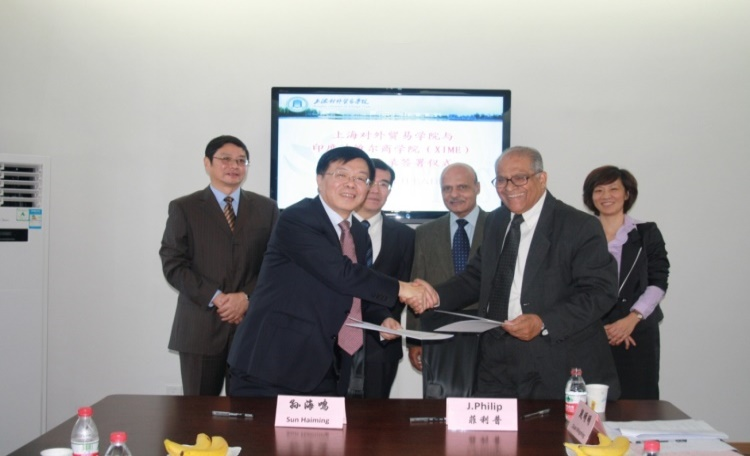
Prof. Sun Haiming, President Shanghai Institute of Foreign Trade, Shanghai and Prof. J. Philip exchanging MOU on 15th October 2011. Prof C.P. Ravindranathan, Hon. Professor XIME looks on.
Publications by Prof J Philip
Along with his contributions to teaching, training and HRD, he has authored a number of books and also presented papers at various national and international fora, many of which have been published in leading journals and magazines. Some of them are given below:
Honours and Awards
.png)
Prof. J. Philip, President XIME receiving the AIMA Kewal Nohria Award for Academic Leadership in Management Education for 2011 from Dr. Narendra Jadhav, Member, Planning Commission, flanked by Mr. Gautam Thapar, President AIMA and Ms. Rekha Sethi, Director General, AIMA.
The Indian Society for Training and Development (ISTD) honoured Prof. J. Philip as its ‘President Emeritus’ on July 25, 2009, Prof. J. Philip was President of ISTD during 1979-80 when he was VP (HR) of the Oberoi Group of Hotels. It is a prestigious designation conferred on past presidents of ISTD for their outstanding contributions in the field of HRD.
Some of the recent honours are:
XIME’s Vision
To be a premier Management institution that shapes leaders and entrepreneurs with a commitment to sustainability and social equity in a technologically enabled world.
XIME’s Mission
1. To deliver superior education in the disciplines and arts of management through academic excellence anchored in practical learning and research.
2. To foster in its students traits of ethical leadership as well as devotion to socially responsible business and sustainability.
3. To endow its students with analytical and advanced technological skills to assure effective and successful performance in the contemporary world.
4. To promote among its students entrepreneurial thinking, innovative disposition, and a global mindset.
XIME’s Values
PEO Statements:
PEO1 : The students will be able to assume managerial roles in business, industrial, or other organizations and/or undertake entrepreneurial ventures that would drive economic growth and technological innovation in the country.
PEO2: The students will attain all-around professional and personal development by dint of analytical, problem-solving, and decision-making capabilities combined with soft skills.
PEO3: The students will imbibe the best Corporate Governance practices and have it in them to take decisions upholding high societal values and professional ethics.
PEO4: The students will be proficient in teamwork as future managers with a global perspective as well as the potential to achieve organizational goals while having the mindset to act responsibly towards all stakeholders.
Program Outcomes - PGDM
| Programme Outcome No. | Programme Outcome |
|---|---|
| PO1 | Apply knowledge of management theories and practices to solve business problems. |
| PO2 | Foster analytical and critical thinking abilities for data-driven and evidence - based decision-making, leveraging the latest technologies and digital tools. |
| PO3 | Develop value-based leadership skills. |
| PO4 | Ability to understand, analyze and communicate global, economic, legal, and ethical aspects of business |
| PO5 | Ability to lead themselves and others in the achievement of organizational goals, contributing effectively to a team environment. |
| PO6 | Integrate principles of sustainability into business strategies, emphasizing environmental stewardship, social equity, and economic viability. |
| PO7 | Ability to demonstrate an innovative and entrepreneurial mindset in dynamic business environments. |
Program Outcomes - PGDM-BA
| Programme Outcome No | Programme Outcome |
|---|---|
| PO1 | Apply knowledge of management theories and practices to solve business problems with data-driven approaches. |
| PO2 | Foster analytical and critical thinking skills to extract insights from data, using the latest technologies and digital tools. |
| PO3 | Develop value-based leadership skills. |
| PO4 | Ability to understand, analyze, and communicate global, economic, legal, and ethical aspects of business. |
| PO5 | Ability to lead themselves and others in the achievement of organizational goals, contributing effectively to a team environment. |
| PO6 | Examine sustainability principles to incorporate business analytics, emphasizing environmental responsibility, fair data practices, and economic sustainability. |
| PO7 | Ability to demonstrate an innovative and entrepreneurial mindset in dynamic business environments. |


Fill the common application form

An Expert Counsellor from our Team will be assigned to you.

Tell us your preferred college and location for seat allocation assistance.

You are finally in your dream college.
Fill the common application form
An Expert Counsellor from our Team will be assigned to you.
Tell us your preferred college and location for seat allocation assistance.
You are finally in your dream college.


Join a community of passionate learners. Access expert-led courses, flexible learning, and more. Start today!
Welcome to our FAQ! Here, you’ll find quick answers to common questions about our online courses, covering enrollment, course format, certification, and support. For anything else, feel free to contact us!